Geometry Analysis
Geometrical properties
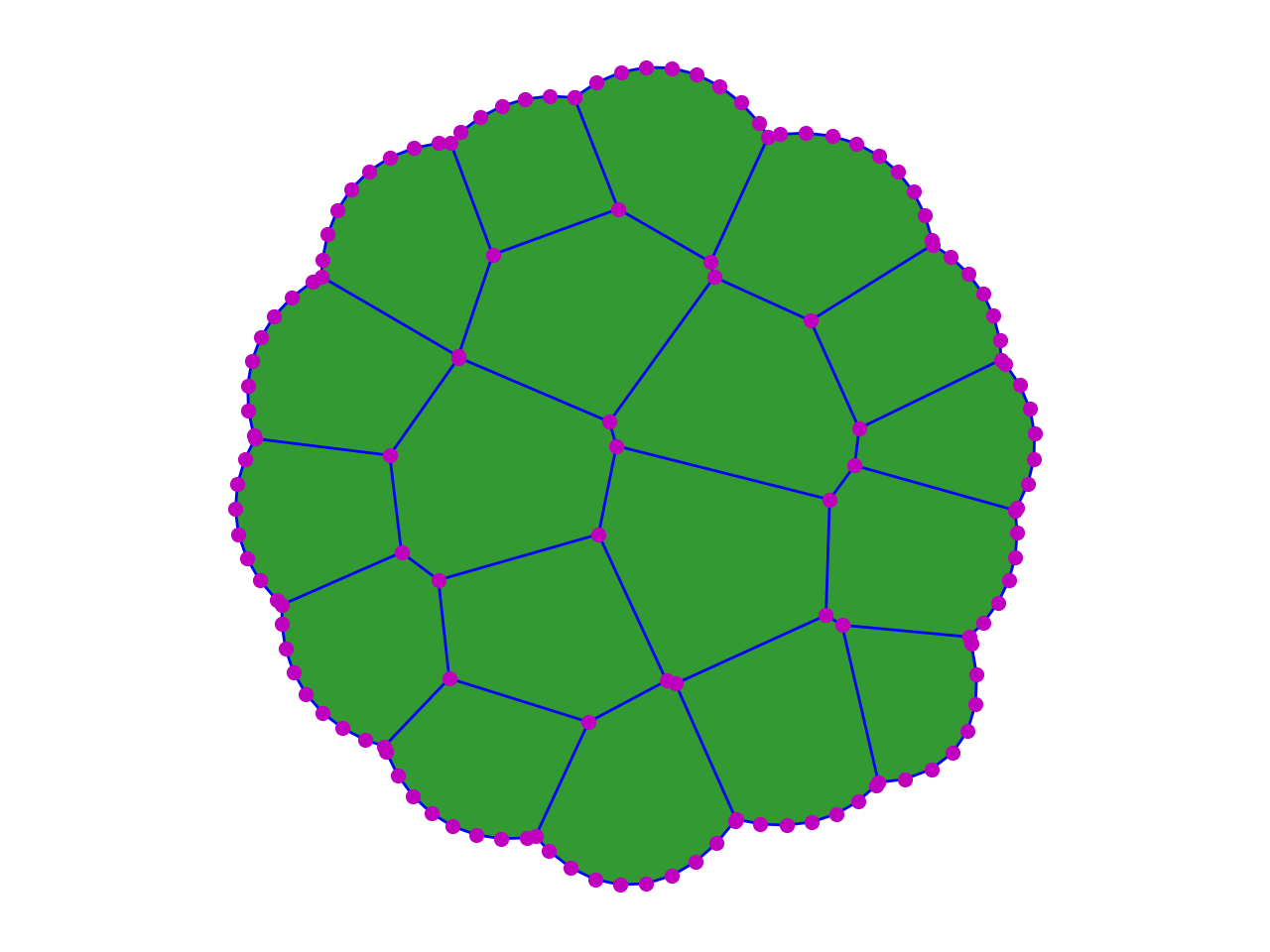
The CellComplex library comes with tools to automatically compute a whole range of geometrical properties on the tissue mesh (compute_topomesh_property) and to propagate properties between elements of different dimensions (compute_topomesh_vertex_property_from_faces for instance). First, let’s create a multicellular complex with random cell shapes using circle_voronoi_topomesh.
1 2 3 | from cellcomplex.property_topomesh.example_topomesh import circle_voronoi_topomesh
topomesh = circle_voronoi_topomesh(3)
|
(Source code, png, hires.png, pdf)
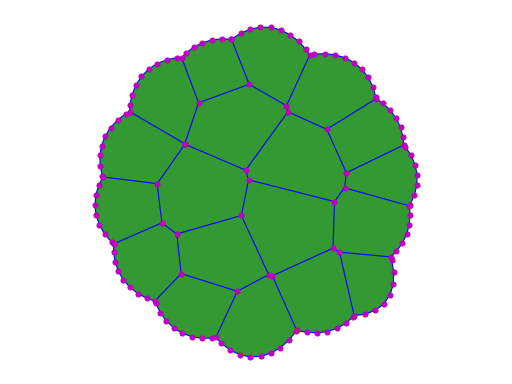
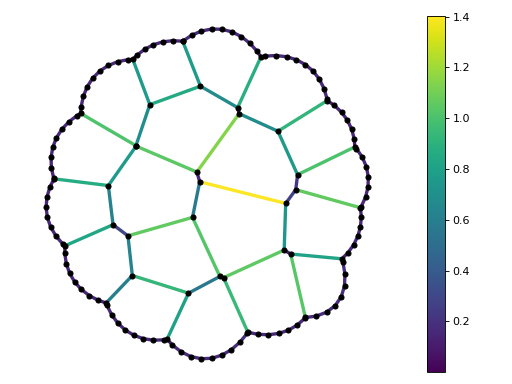
A straightforward property to compute is for instance the length of all the edges. This computation is performed very simply by calling the compute_topomesh_property on a PropertyTopomesh object with the arguments 1 for dimension and 'length' for property name. Being one of the pre-defined property names, the property 'length' will be added to the wisps of dimension 1 and the computed length value will be assigned to each ID.
Note
The list of pre-defined (computable) property names can be found at the bottom of this page, or in the documentation of the function compute_topomesh_property
1 2 3 | from cellcomplex.property_topomesh.analysis import compute_topomesh_property
compute_topomesh_property(topomesh,'length',1)
|
(Source code, png, hires.png, pdf)
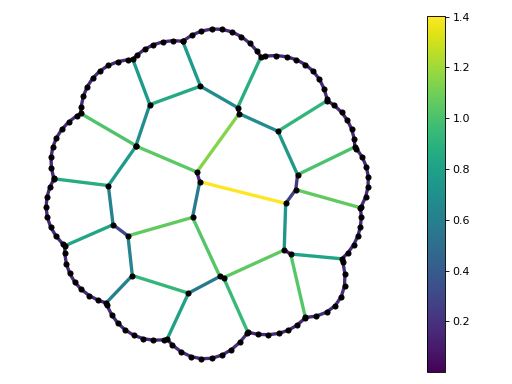
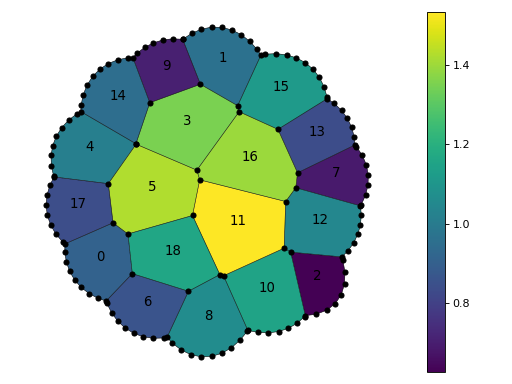
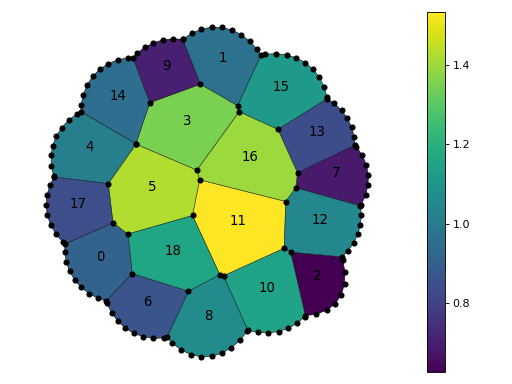
Similarly, it is possible to compute the area of the faces with just one function call. The method takes advantage of the storage of properties in NumPy based structures to perform computations efficiently on whole arrays of values instead of looping on the mesh elements.
1 2 | compute_topomesh_property(topomesh,'area',2)
print(topomesh.wisp_property('area',2))
|
{0: 0.9092855414754071,
 1: 0.96649956740289,
 2: 0.6270843768350033,
 3: 1.3496005090046475,
 4: 1.0153916778136718,
 5: 1.425343737120764,
 6: 0.863140023276767,
 7: 0.688484985614696,
 8: 1.0622081816602609,
 9: 0.7054585275907782,
 10: 1.1532886832605143,
 11: 1.5323925705923283,
 12: 1.0469905848920904,
 13: 0.8364178763830168,
 14: 0.9512681918544135,
 15: 1.1161306160901407,
 16: 1.396702833427955,
 17: 0.8403108600291247,
 18: 1.161257331179229}
(Source code, png, hires.png, pdf)
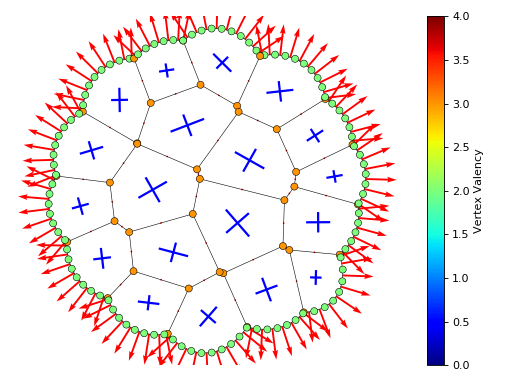
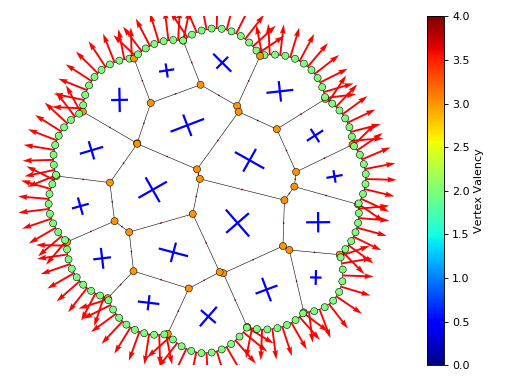
The compute_topomesh_property function offers the possibility to compute a great number of numerical properties on each element of the mesh. The following lines show for example how to compute the valency of all vertices in the mesh, the normal vectors on the contour edges of a 2d shape, or the inertia tensors describing the principal directions of the mesh faces.
1 2 3 | compute_topomesh_property(topomesh,'valency',0)
compute_topomesh_property(topomesh,'normal',1)
compute_topomesh_property(topomesh,'inertia_tensor',2)
|
(Source code, png, hires.png, pdf)
3D Example : Curvature
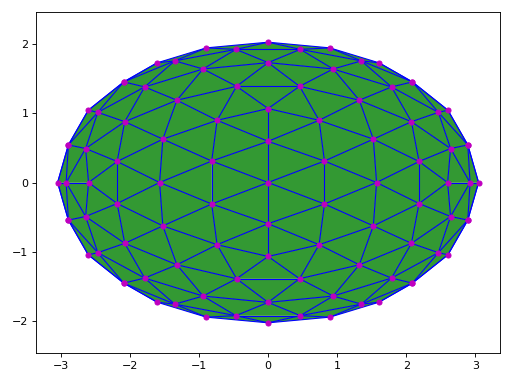
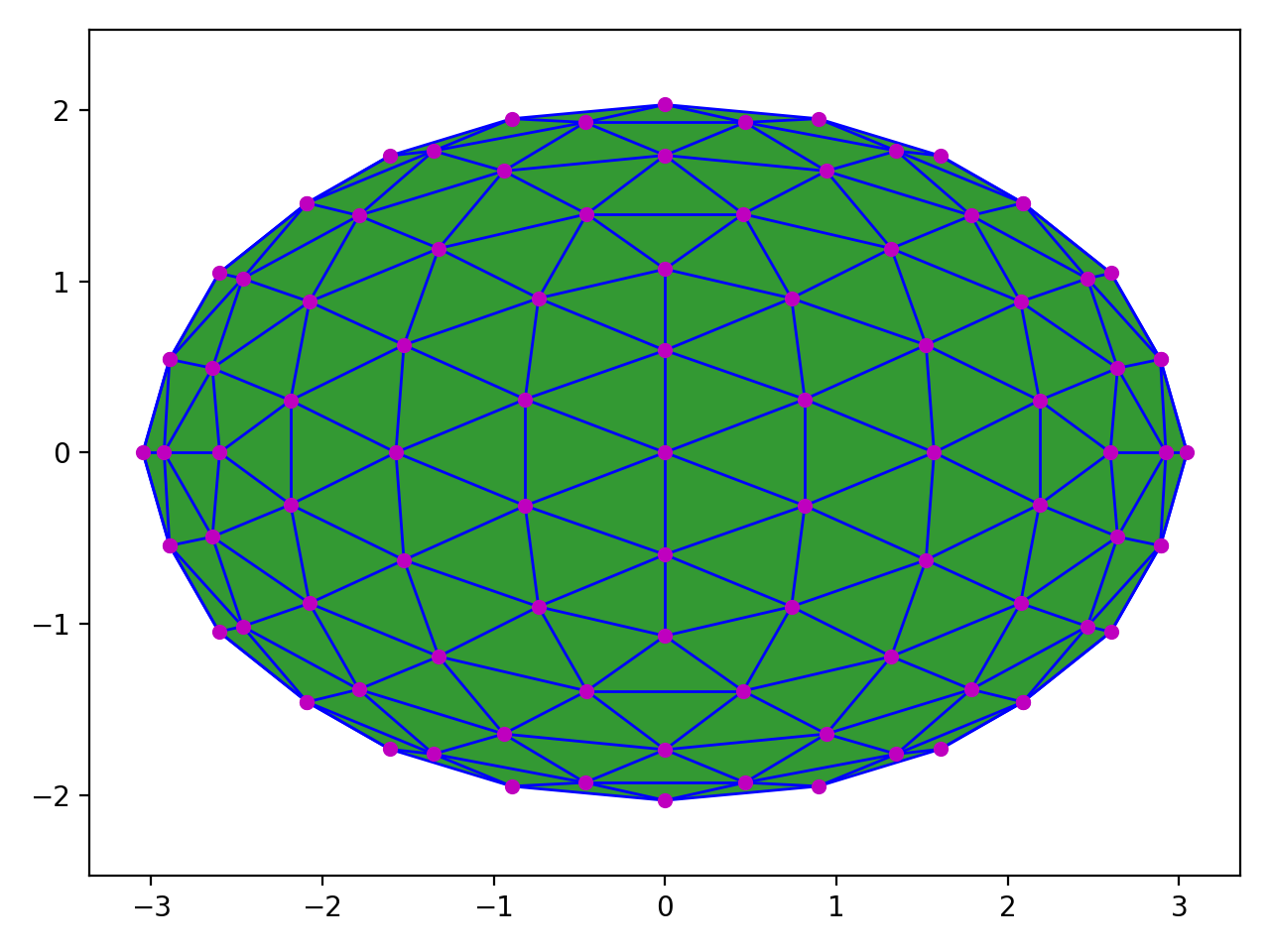
Now, let’s consider a 3D example. The example_topomesh module provides several simple 3D shapes that can be represented as a PropertyTopomesh. Here, we generate a 3D ellipsoid elongated along the X axis, represented as a triangular mesh, and keep only the upper (Z>0) part of the surface.
from cellcomplex.property_topomesh.example_topomesh import vtk_ellipsoid_topomesh
from cellcomplex.property_topomesh.extraction import cut_surface_topomesh
from cellcomplex.property_topomesh.utils.matplotlib_tools import mpl_draw_topomesh, mpl_draw_incidence_graph

topomesh = vtk_ellipsoid_topomesh(ellipsoid_radius=2,ellipsoid_scales=[1.5,1,1],subdivisions=2)
topomesh = cut_surface_topomesh(topomesh,z_offset=0,below=False)
(Source code, png, hires.png, pdf)

Based on this mesh, we would like to compute the curvature of the surface. To do so, we will use the function compute_topomesh_property to compute the geometrical properties allowing to obtain this information.
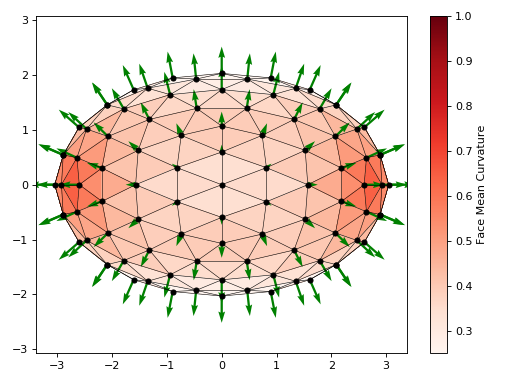
The first property to compute is the normal of the faces (elements of degree = 2). Given the implementation as an incidence graph, the order of vertices for each face is not unambiguous, hence the orientation of faces is not contained in the surface. It is necessary to have a way of re-orienting consistently the normals. Here we choose the orientation mode that propagates the orientation infomration in a topologically accurate way on a connected surfacic mesh.
1 | compute_topomesh_property(topomesh,'normal',2,normal_method='orientation')
|
Next, we compute the area of all faces, and use it to compute the normal property on the vertices (elements of degree = 0). This is done by averaging the normals of faces neighboring each vertex using the function compute_topomesh_vertex_property_from_faces. This function is a generic tool that allows to propagate properties between elements of different dimensions.
1 2 | compute_topomesh_property(topomesh,'area',2)
compute_topomesh_vertex_property_from_faces(topomesh,'normal',weighting='area',adjacency_sigma=1.2,neighborhood=3)
|
Once each vertex bears a consistent normal, it is possible to compute the mean curvature of the each face, using a discrete curvature estimator. This property can be propagated to the vertices using the same method as for the normals.
1 2 | compute_topomesh_property(topomesh,'mean_curvature',2)
compute_topomesh_vertex_property_from_faces(topomesh,'mean_curvature',weighting='area',adjacency_sigma=1.2,neighborhood=3)
|
(Source code, png, hires.png, pdf)
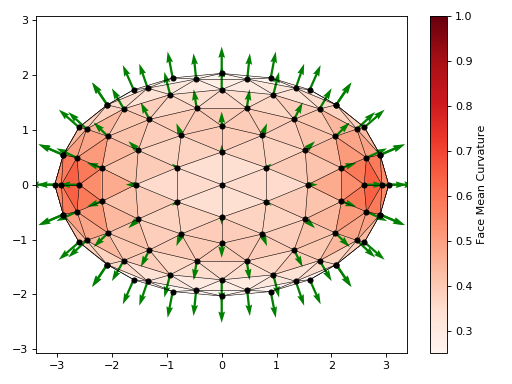
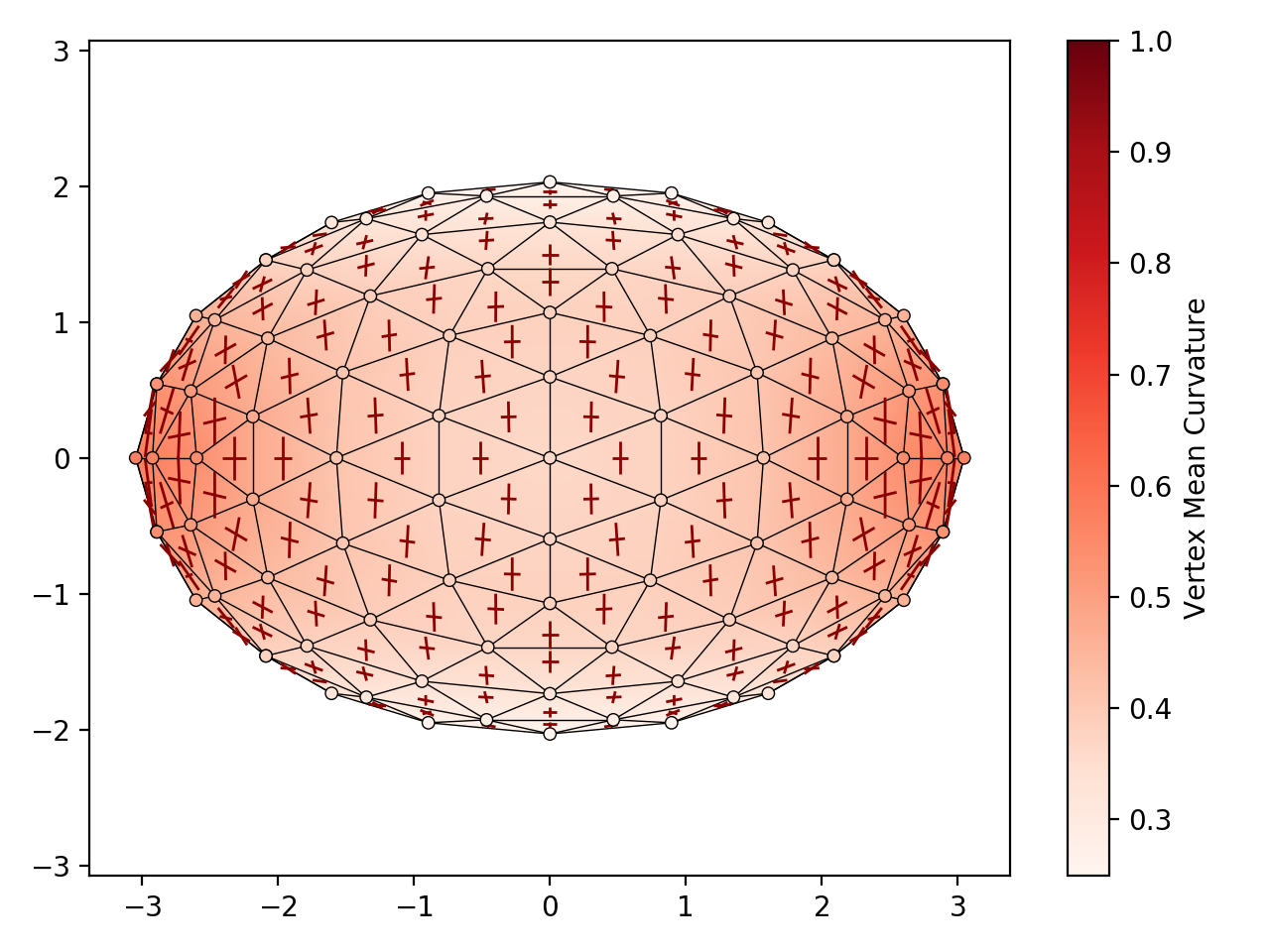
The numerical property defined on vertices can then be visualized on the triangles of the mesh, creating a smooth interpolation of curvature values.
While estimating the mean curvature of the faces, the algorithm also has filled other properties such as the 3D curvature tensor containing all the information on the principal curvatures, in particular mean, gaussian, min and max curvatures. This can be useful for instance to visualize principal directions of curvature on the faces. As a tensor, it is stored as a 2d NumPy array for each wisp of dimension 2.
1 | print("Face 0 : ",topomesh.wisp_property('principal_curvature_tensor',2)[0])
|
Face 0 :  [[ 2.41008840e-01 -6.01676202e-17 -2.43084355e-17]
           [-1.23938667e-17  3.13548659e-01  2.67055929e-01]
           [ 2.88344294e-18  2.67088173e-01  2.27484565e-01]]
(Source code, png, hires.png, pdf)
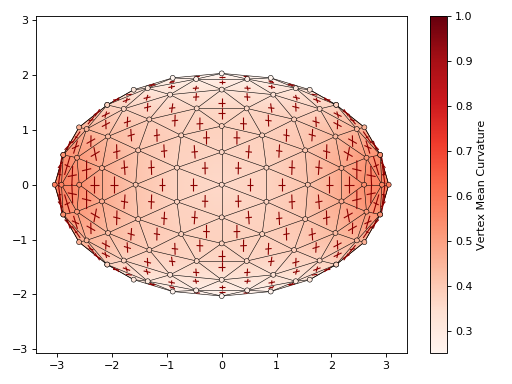
Computable geometrical properties
A list of geometrical properties that can be passed as property_name argument to the function compute_topomesh_property, along with the wisp dimension for which they can be computed:
property_name |
0 |
1 |
2 |
3 |
type |
|---|---|---|---|---|---|
|
o |
x |
x |
x |
vector |
|
x |
scalar |
|||
|
x |
scalar |
|||
|
x |
scalar |
|||
|
x |
x |
x |
vector |
|
|
x |
scalar |
|||
|
x |
scalar |
|||
|
x |
scalar |
|||
|
x |
scalar |
|||
|
x |
scalar |
|||
|
x |
tensor |
|||
|
x |
vector |